OpenZhenZhen AI 提示词画廊 · gpt-image-2.5 · image
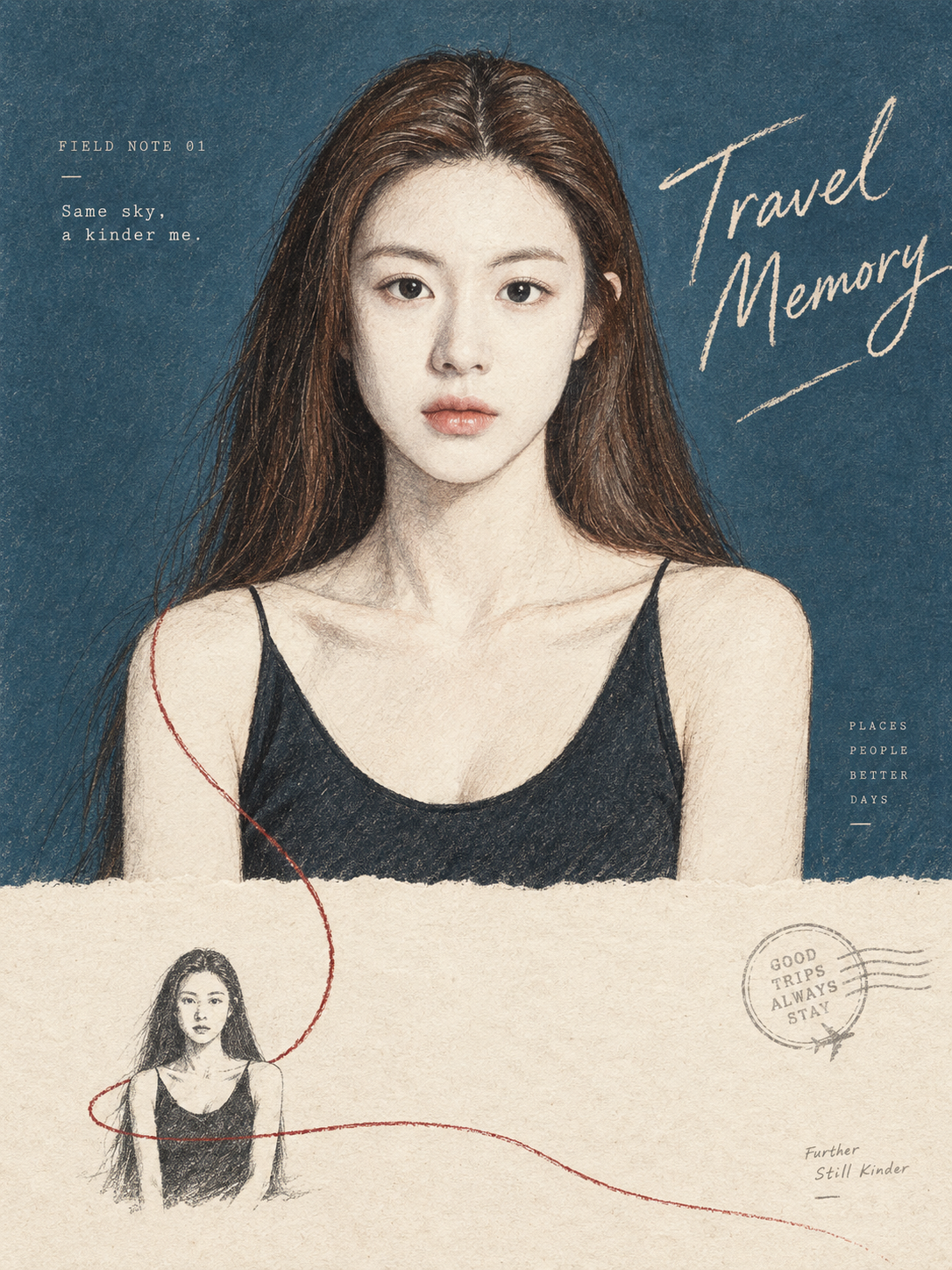
线迹旅行记忆负形海报设计
Stitch Travel Memory Negative Space Poster Design
来自 OpenNana 的图像提示词,已按本地图像分类和站点 gpt-image-2.5 归类整理。 使用时需上传人物参考图;本流程使用统一参考人物生成示例。
提示词 / Prompt
中文提示词
以用户上传的参考图作为主要可见人物的面部身份依据。在不与身份参考冲突的情况下,保留来源的场景、造型、服装、姿势、构图、光线和视觉风格。 将人物渲染为风格化插画,只保留参考图的面部身份特征;不要生成写实摄影人像。 请将我上传的每一张旅行照片分别制作成一张独立的「线迹旅行记忆」编辑海报,每张照片单独输出,不进行多图拼接。 这套风格适合包含1~3名轮廓完整、姿态明确、具有行走、牵手、撑伞、搀扶、滑行、拥抱、攀登或其他方向性动作的人物照片。照片中最好存在道路、栏杆、影子、水岸、绳索、轨道或运动痕迹,可以发展为贯穿画面的连续线迹。 整体采用3:4竖版双层结构,但不是普通的照片与插画上下对比,而是“上部人物被挖空、下部人物被补回”的负形记忆结构。 上部约占画面58%~66%。 忠实保留原始照片中的环境摄影,包括建筑、道路、山水、天空、光影、透视、天气、地点色彩和空间关系,仅进行轻微灰化、粉质化与旧艺术出版物调色。 将照片中的人物按照原始数量、位置、尺度、姿态、动作方向、身体重叠和接触关系,完整替换为温暖纸白色的负形剪影。 人物负形必须准确覆盖原人物原本的位置,不得移动、放大或改变姿态。边缘清晰但略带纸张纤维,只使用极少量石墨内线暗示头发、手部、衣服分界、背包、雨伞、相机或动作接触点。 上部人物内部不能继续保留摄影颜色,也不能只添加一圈白色描边。观者应该感觉人物已经从真实场景中离开,只留下一个准确的纸白空位。 下部约占画面34%~42%。 使用温暖米白色粗纹纸张作为连续背景,将上部同一组人物以完全相同的姿态、数量、动作关系和核心物件,缩小后重新补回为深炭灰、褪黑墨或石墨实心人物回声。 下部人物通常占下半区域宽度20%~42%、高度25%~55%,明显小于上部负形。根据原照片的动作方向,将其放置在偏左、偏右或中下区域,与上部人物形成垂直、斜向或运动方向上的呼应。 下部至少保留55%的连续纸白。只允许使用一至三条极淡石墨线暗示道路、山坡、栏杆、水岸或环境方向,不得重新绘制完整背景。 从照片中选择一条具有真实意义的动作或环境线索,例如: - 人物牵手的位置 - 雨伞伞柄 - 相机背带 - 行走脚步 - 山路曲线 - 桥面透视线 - 栏杆方向 - 滑行轨迹 - 水岸或人物影子 将它发展为一根赭红、暗红、灰蓝或铁锈红色的连续手绘线。 主线必须具有铅笔、蜡线或缝线般的真实材质,出现轻微抖动、粗细变化、停顿、回旋和断续压力。它应从上部人物的真实动作接触点出发,顺着照片环境方向延伸,跨过水平分界,再连接或环绕下部人物的对应手部、脚步或核心物件。 线迹不能在上下分界处突然停止,也不能变成光滑的数字路径或无意义装饰。 色彩保持克制。上部保留照片的主要地点色彩,但降低杂色与饱和度;人物负形使用暖纸白。下部以暖白、炭灰、褪黑墨为主,从照片中提取一至两种低饱和环境色作为极淡辅助轨迹,并使用一根暗红或灰蓝主线连接上下。 根据照片中的真实地点、动作和情绪加入: - 一个1~3个英文单词的主标题; - 一个简短字段,如“FIELD NOTE 01”; - 一句5~12个英文单词的观察句。 观察句必须在提示词中提前逐字确定,并拆成2~4段,沿道路、人物动作方向或主线弧度分布在上下两层。至少一段文字应与跨区主线发生贴近、缠绕或延续关系。 字体使用纤细、略显迟疑的手写体、铅笔小写或蜡线般书写。文字可以沿曲线轻微旋转,但必须清楚可读。主标题应位于下部连续留白中,在聊天预览尺寸下仍然能够辨认。 避免:普通上方照片下方插画、上部人物仍保留摄影填充、仅添加白色轮廓、人物负形偏离原位、上下人物姿态不同、人物数量变化、下部人物过大、下部完整重画环境、线迹在分界处停止、光滑矢量路径、时尚人物剪影、彩色卡通、密集装饰、规整数字文本框、作者名、签名、Logo、网址、二维码、水印和假字。 最重要的规则:上部看见的是人物离开后留下的准确纸白空位;下部看见的是同一个动作被缩小后重新落回纸面。一根具有手工材质的线和沿线文字,必须把两个相同姿态连接成同一段旅行记忆。
English prompt
Use the uploaded reference image as the facial identity reference for the main visible person. Keep the source scene, styling, clothing, pose, composition, lighting and visual style unless they conflict with the identity reference. Render the person as a stylized illustration that preserves the reference facial identity cues; do not turn the result into a photorealistic camera portrait. Please turn each travel photo I upload into an independent "Stitch Travel Memory" editorial poster, outputting each photo separately without any multi-image stitching. This style is suitable for photos of 1–3 people with complete silhouettes and clear postures, involving actions such as walking, holding hands, holding umbrellas, supporting each other, gliding, hugging, climbing, or other directional movements. It is best if the photos contain roads, railings, shadows, waterfronts, ropes, tracks, or movement traces that can be developed into a continuous stitch line running through the frame. The overall design adopts a 3:4 vertical double-layer structure, but it is not a common top-photo-bottom-illustration contrast; instead, it is a "negative memory structure" where the upper figures are hollowed out and the lower figures are filled back in. The upper part accounts for approximately 58%–66% of the frame. Faithfully preserve the environmental photography from the original photo, including architecture, roads, mountains/water, sky, light and shadow, perspective, weather, location colors, and spatial relationships, applying only slight desaturation, a powdery texture, and old art publication color grading. The figures in the photo, following their original count, position, scale, posture, movement direction, body overlap, and contact relationships, are to be completely replaced with warm paper-white negative silhouettes. The figure negatives must accurately cover the original positions of the figures, without moving, enlarging, or changing their postures. Edges should be clear but with a slight paper fiber texture, using only minimal graphite inner lines to hint at hair, hands, clothing boundaries, backpacks, umbrellas, cameras, or movement contact points. The interior of the upper figures cannot retain photographic colors, nor can it just have a white stroke added. The viewer should feel that the people have left the real scene, leaving behind only an accurate paper-white vacancy. The lower part accounts for approximately 34%–42% of the frame. Use warm off-white coarse-textured paper as a continuous background. Reintroduce the same group of people from the upper part in identical postures, counts, movement relationships, and core objects, reduced in size and filled back in as deep charcoal grey, faded black ink, or graphite solid "figure echoes". Lower figures typically occupy 20%–42% of the width and 25%–55% of the height of the lower area, significantly smaller than the upper negatives. Based on the original movement direction, place them in the left-leaning, right-leaning, or center-bottom area to create a vertical, diagonal, or movement-directional echo with the upper figures. The lower part must maintain at least 55% continuous paper white. Only one to three extremely faint graphite lines are allowed to hint at roads, hillsides, railings, waterfronts, or environmental directions; do not redraw a complete background. Select a real meaningful movement or environmental clue from the photo, such as: the position of held hands, an umbrella handle, a camera strap, walking footsteps, a mountain road curve, bridge deck perspective lines, railing directions, a gliding trajectory, waterfronts or figure shadows. Develop it into a continuous hand-drawn line in ochre red, dark red, grey-blue, or rust red. The main line must have the authentic texture of a pencil, wax line, or stitching, showing slight jitters, thickness variations, pauses, loops, and intermittent pressure. It should start from a real action contact point of the upper figures, extend along the photo's environmental direction, cross the horizontal boundary, and then connect to or surround the corresponding hand, foot, or core object of the lower figures. The stitch line cannot suddenly stop at the upper-lower boundary, nor can it become a smooth digital path or meaningless decoration. Keep colors restrained. The upper part retains the primary location colors of the photo but with reduced noise and saturation; figure negatives use warm paper white. The lower part is dominated by warm white, charcoal grey, and faded black ink, with one or two low-saturation environmental colors extracted from the photo as extremely faint auxiliary traces, using one dark red or grey-blue main line to connect the top and bottom. Based on the real location, action, and emotion in the photo, include: a main title of 1–3 English words; a short field, such as "FIELD NOTE 01"; one observation sentence of 5–12 English words. The observation sentence must be determined word-for-word in the prom
探索更多图片和视频提示词 · 生成图片 · 生成视频 · 在 AI 画布中创作
相关作品
- 银发女信使
以参考图的侧脸构图、逆光方向和深蓝背景为参考,呈现一位原创奇幻女信使的真人摄影肖像。整体干净、清透、精致,具有高端人像写真的自然质感。 人物约25岁,清冷安静,面容柔和而坚毅。浅暖肤色均匀透亮,保留轻微、细腻的真实皮肤纹理,妆容清淡,眼下与鼻翼肤色干净。琥珀色眼睛清澈明亮,睫毛自然,嘴唇呈柔和的裸玫瑰色。 银灰色及肩发,发梢带极淡的烟紫色,发质柔顺、有轻盈光泽。偏分刘海整齐分束,后侧细辫收束成低半扎发。微风从左向右吹起少量脸侧发束,形成舒展、流畅的弧线;额头、眼睛和脸颊保持清晰,头顶轮廓整洁,只有少量自然碎发。 墨绿色旅行外套采用细密平整的精纺面料,剪裁利落,非对称翻领搭配细窄黄铜色包边
- 创越大唐之皇子爱上宫女
**画幅:16:9 横屏。** 真实唐代历史电影剧照,一场宫门前即将失控的对峙。宏大的唐式宫城前庭,厚重朱漆宫门、宽阔台基、灰瓦门楼与两侧长廊构成深远空间。建筑具有可信的木构比例与材料质感,石铺广场开阔,陈设疏朗,历史气息厚重。 画面下方偏左,一位约25岁的成年女主站在台阶前,容貌明艳,体态丰腴匀称,胸部丰满,身穿石榴红织锦抹胸与浅赭金色高腰长裙,米白披帛自然垂在臂间,高髻佩戴简洁金簪。她右手攥紧一封封缄文书,左手抓住男主的衣袖,肩颈微微绷紧,警惕地望向拦路的将领,眉头轻蹙,嘴唇紧闭,神情中有惊惧,也有不肯退让的坚定。 约30岁的男主穿深青色圆领袍、束革带,侧身挡在女主前方半步,保持女主
- 夜兰花舞女
真人古装电影夜景剧照,一位约25岁的成年唐代美女在临水亭榭中轻盈起舞,脸庞丰润,身材丰满匀称,神情温柔。身穿月白色绣花抹胸与灰蓝色丝绸长裙,浅色披帛从臂弯延伸,发髻佩戴珍珠簪饰。她侧身抬臂,脚尖轻点地面,目光追随指尖,裙摆自然转动。背景可见深色水面、荷叶与木质栏杆,近处灯笼照亮脸庞和上身,柔弱的冷色夜光勾勒发丝与肩部轮廓。采用真实夜景电影色调,蓝灰环境色与少量暖黄灯光相互呼应,肤色保持自然,夜色深沉,黑位有层次,金属与水面反光不过曝。全身横向构图,水面倒影轻微破碎,保留低照度摄影的细腻颗粒,皮肤与布料质感真实。
- 牡丹春庭
真人古装电影剧照,一位约25岁的成年盛唐美女在牡丹庭院中翩翩起舞,面容明媚,胸部丰满,体态丰腴柔美,腰腹曲线自然。身穿藕粉色刺绣抹胸、浅绯色长裙与米杏色披帛,云鬓间簪一朵牡丹。她轻盈转身,抬手展腕,笑容松弛自然,披帛与裙摆沿着动作方向扬起。庭院里可见真实的花枝、青石小径、木窗与斑驳墙面,柔和春日天光照亮人物,树叶投下疏淡阴影。真实电影色彩,粉色柔和,叶片呈自然灰绿色,肤色通透但保留细微色差,白色与浅色衣料保留纹理,高光不过亮,整体对比适中,带细微胶片颗粒。平视全身构图,环境有清晰空间层次,无浓重滤镜、无人工光晕、无蜡像肤质。
- 大唐舞女-1
真人古装电影剧照,一位约25岁的成年唐代美女在宫殿中翩翩起舞,五官明艳,体态丰腴,胸部丰满,肩颈圆润,身体比例自然。身穿暗朱红色金线刺绣抹胸与柔软的香槟金长裙,披帛绕过双臂,高髻佩戴精巧金步摇。她旋身回眸,双臂舒展,裙摆随动作展开,衣料呈现真实重量、褶皱和垂坠感。背景是木质宫柱、屏风与石砖地面,侧面宫窗透入柔和日光,殿内保留自然阴影。真实电影调色,暗红沉稳,金色克制,肤色自然偏暖,高光柔和过渡,暗部保留木纹与衣料细节,带轻微胶片颗粒。平视全身构图,人物完整入镜,面部清晰,飞扬的披帛边缘带少量运动模糊,保留皮肤毛孔与细小绒毛,无磨皮、无CG感。
- 清水寺极简手绘旅行海报
日式建筑速写风格的方形旅行海报。准确中文默认值:清水寺、京都、日本;英文默认值:KIYOMIZU-DERA TEMPLE、Kyoto、JAPAN。画面仅有一位绑定固定参考 ref-10a-v1 的远景游客。